Suzerain: A text-driven political RPG about moral leadership
Suzerain by Torpor Games is a political drama RPG placing you as the newly elected president of a fractured republic. It channels decision-making into narrative consequence through branching dialogue and policy choices, forcing trade-offs between ideology and stability. The game includes an in-game Codex for deep lore and a Political Compass that maps ideological shifts across play. It suits players who favor narrative-heavy RPGs, political simulation, and slow, deliberate decision-driven storytelling grounded in consequence.
Suzerain puts political conversation ahead of map-level strategy
Expect a text-first, role-playing experience rather than a wargame. You inhabit Anton Rayne in a fictional 1950s republic recovering from civil war, where choices carry moral ambiguity and institutional weight. The base game is primarily text; when conflict occurs, the title moves into a strategic planning phase for military decisions. A typical first run takes about 10 to 15 hours, keeping each playthrough concise enough for multiple attempts.
Cabinet, lawmaking, and crises create systemic consequences
Systems reward political thinking, not reflexes. You manage ministers with competing agendas, propose constitutional reforms, balance a national budget and steer economic recovery through policy. The game defines explicit failure states tied to political outcomes, including:
- removal from office via military coup
- losing the next election or being assassinated
- triggering an escalatory conflict that becomes a nuclear crisis
Those end states underline that choices have long-term, tangible risks.
The presentation is text-led, anchored by an extensive in-game reference
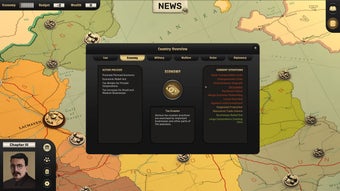
The interface focuses on readable text and context rather than cinematic spectacle. An internal Codex provides an encyclopedia of characters, cities and institutions that keeps the world coherent while you read. The title runs on Windows and lists modest minimum requirements, including an Intel Core 2 Quad Q6600, 4 GB of RAM and 2 GB of storage, and it also exists on several other platforms.
Deterministic outcomes and branching paths drive replayability
Replaying changes political alignment and endings rather than random events. The Political Compass records ideological shifts, and dozens of ending variations arise from different alignments, economic performance and personal choices. The game contains no random chance, so outcomes follow directly from prior decisions. Its writing has earned recognition, including a Games for Change People’s Choice Award and a German Computer Game Award.
In summary, Suzerain is a demanding, reflective political role-play for patient decision-makers
The game rewards players who want to live inside a heavy, consequence-driven role and accept morally ambiguous trade-offs. It asks for sustained attention to dialogue and institutional detail, and it does not cater to those seeking action-oriented or visually driven entertainment. For readers who favour slow, character-led statecraft over spectacle, Suzerain offers a concentrated and morally complex experience.
.png)